Employee pay and contractor income are not the same thing
A contractor's day rate looks generous next to an employee's salary, but it has to cover things an employer would otherwise pay for: superannuation, paid leave, public holidays, sick days, equipment, insurance and the weeks between contracts. This calculator turns a day rate, hourly rate or annual revenue into a realistic take-home estimate for a sole trader, so you can compare it with a permanent role or decide what rate to quote.
It treats you as an Australian resident sole trader. Companies, trusts and partnerships are taxed differently, and the calculator does not decide whether you are legally a contractor or an employee — that depends on the whole working relationship, not on having an ABN.
How to use it
- Choose whether to start from a day rate, hourly rate or annual revenue. Enter rates excluding GST.
- Set billable weeks. 46 allows roughly four weeks' leave and two weeks of public holidays; use fewer if you expect gaps between contracts.
- Enter your business expenses for the year.
- Choose a super percentage to set aside. The calculator treats it as a personal deductible contribution, which lowers taxable income.
- Tick GST registration if it applies, and the study loan box if you have one.
How the estimate works
Revenue minus expenses gives net profit. The super set-aside is subtracted to give taxable income, on the assumption you claim it as a deduction (you must lodge a notice of intent with your fund to do this). Income tax is calculated on 2026–27 resident rates less LITO, plus the 2% Medicare levy and any study loan repayment. Take-home is profit minus super and those taxes.
Worked example
A contractor billing $150,000 excluding GST with $15,000 of expenses has a profit of $135,000. Setting aside 12% ($16,200) leaves taxable income of $118,800. Income tax is $26,160 and the Medicare levy $2,376, so take-home is about $90,264 — around $1,735.85 a week across the year.
For reference, an $800 day rate for five days a week over 46 weeks is $184,000 in revenue before expenses.
GST is not your money
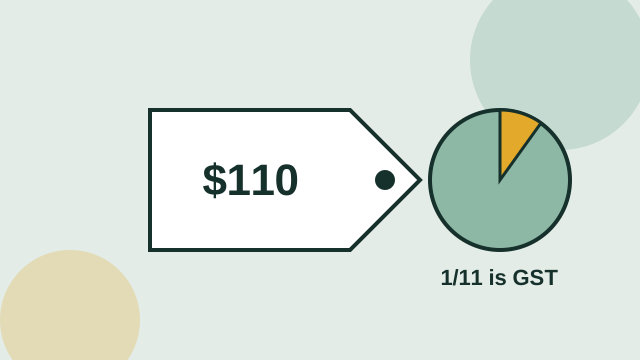
If you are registered for GST, you add 10% to your invoices and pay it to the ATO through your business activity statement, less GST credits on your business purchases. The calculator shows GST separately and never counts it as income. Registration is generally required once your GST turnover reaches $75,000 a year. Use the GST calculator for individual invoice amounts.
No tax is withheld for you
Employees have tax withheld from every pay. Sole traders don't, unless they ask a client to withhold under a voluntary agreement. After your first tax return with business income, the ATO usually puts you into PAYG instalments, which spread next year's tax across quarterly payments. The tax amount in the result is a guide to how much to keep aside each week.
Comparing with an employee role
To compare like for like, run the employee salary through the take-home pay calculator with super on top, then compare it with this result plus the super you set aside. Remember the employee also receives paid annual leave, personal leave and redundancy protections that a contractor funds personally.
Setting a day rate
A quick way to set a rate is to work backwards. Decide what you want to take home, add the tax and super shown here, add your expenses, then divide by realistic billable days. Many contractors find that matching a permanent salary needs a day rate of roughly the annual salary divided by 220, before allowing for gaps between contracts.
Frequently asked questions
How much tax do sole traders pay in Australia?
Sole traders pay individual income tax rates on their business profit, plus the Medicare levy. In 2026–27 that means 15% on profit between $18,201 and $45,000 and 30% up to $135,000.
Do contractors have to pay their own super?
Sole traders aren't required to make super contributions for themselves, but setting money aside is strongly recommended. Contributions can be tax-deductible if you lodge a notice of intent.
Is GST included in my income?
No. GST you collect belongs to the ATO and is paid through your BAS.
When do I need to register for GST?
Generally when your GST turnover is $75,000 or more a year. Taxi and ride-share drivers must register regardless of turnover.
Does having an ABN make me a contractor?
No. Whether you are an employee or contractor depends on the real working relationship. The Fair Work Ombudsman and ATO have guidance on the difference.