Payday Super explained: what changed on 1 July 2026
Super is now paid every payday instead of every quarter. Here's what that means for your payslip, your fund and — if you employ people — your payroll.
The short version
Since 1 July 2026, employers must pay the super guarantee for each payday rather than up to four times a year. The contribution has to reach the employee's super fund within seven business days of payday. The rate is unchanged at 12% of qualifying earnings. The ATO's free Small Business Superannuation Clearing House closed on the same day.
Why the change was made
Under quarterly payment, an employer could legally hold an employee's super for up to four months. If the business failed or simply didn't pay, workers often found out months later, when recovery was hardest. Paying super with wages means smaller, regular contributions that employees can check against each payslip, and money invested sooner. Over a working life, earlier contributions also have longer to grow.
The timeline that matters
- Payday. The employer pays wages and calculates super on the qualifying earnings in that pay.
- Within seven business days. The super contribution must be received by the employee's fund — not just sent by the employer. Weekends and public holidays don't count.
- If it's late. The super guarantee charge applies to the late amount, and late payment offsets are no longer available.
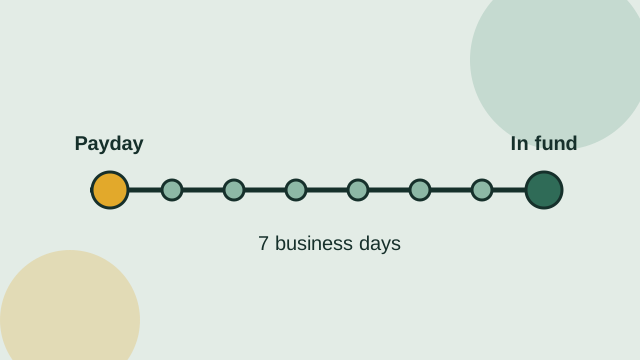
There was a one-off overlap at the changeover. Super for wages paid from April to June 2026 was still due quarterly by 28 July 2026, while wages paid from 1 July 2026 fell under the new rules. Between 1 and 28 July, contributions were applied to outstanding quarterly amounts first.
What employees should check
Your payslip should already show the super your employer calculated. What's new is that you can expect to see that amount in your fund within about a week and a half of each payday. Log in to your fund's app every few pays and match contributions to payslips. If something is missing, raise it with your employer first; if it isn't fixed, you can report unpaid super to the ATO.
You can check any pay amount with our Payday Super calculator, which shows the super owed and the date it must reach your fund.
What employers need to do
Employers need a way to send contributions every pay run. For most that means payroll software with a built-in super payment service or a commercial clearing house, now that the ATO clearing house has closed. Payroll should be set up to calculate super on qualifying earnings for each pay, and to report the new Payday Super information through Single Touch Payroll. Cash flow also changes: rather than a large quarterly payment, super leaves the business account with each pay.
The ATO has published a practical compliance guideline for the first year, from 1 July 2026 to 30 June 2027, describing an education-focused approach for employers who are making a genuine effort to comply and fix errors quickly. That's a compliance stance, not a delay: the law applies from 1 July 2026.
Qualifying earnings in plain English
The super guarantee is calculated on qualifying earnings. For most employees that's their ordinary time earnings — pay for ordinary hours, plus things like shift loadings, commissions and most allowances — and it also includes amounts they have salary-sacrificed into super. Overtime is generally excluded. So an employee on $3,000 a fortnight of ordinary pay gets $360 super per pay at 12%, whatever they choose to salary-sacrifice on top.
Payslips under Payday Super
Payslips still need to show super contributions and the fund they're paid to. Because contributions now track each pay, it's good practice to show the amount for that pay and, if your software supports it, the date it will be paid. Our payslip generator includes fields for the fund, its identifier and the super payment date.
Common questions
Does Payday Super change how much super I get? Not the rate — it's still 12%. You may end up slightly better off because contributions are invested sooner.
What if I'm paid monthly? Super is due within seven business days of each monthly payday.
Does it apply to contractors? It applies wherever the super guarantee applies, which can include some contractors paid mainly for their labour. Genuine independent contractors running their own business usually fund their own super.
A worked example
Sam is paid $3,000 a fortnight for ordinary hours, every second Friday. Under the old rules, his employer could have paid all super for July, August and September — about $2,340 — as late as 28 October. Under Payday Super, $360 must reach his fund within seven business days of each fortnightly payday. If Sam is paid on Friday 13 November 2026, the contribution must be in his fund by Tuesday 24 November, assuming no public holidays in between.
Try it: Payday Super calculator — 12% super for each pay and the date it must reach the fund.