What pro rata means
Pro rata is Latin for "in proportion". A pro-rata salary is the full-time salary scaled to the hours you work. If a role pays $95,000 full-time and you work four days instead of five, you earn 80% of $95,000. Pro-rata pay also applies to leave: part-time employees accrue annual and personal leave in proportion to their ordinary hours.
How to use it
- Enter the full-time salary quoted for the role.
- Enter the hours you'll work each week.
- Enter the employer's full-time hours. 38 is standard; some employers use 37.5 or 40.
- Read your pro-rata salary, FTE and fortnightly pay.
The formula
FTE = your hours ÷ full-time hours. Pro-rata salary = full-time salary × FTE. If you work days rather than hours, use days: three days of a five-day week is 0.6 FTE.
Worked example
A $95,000 full-time role worked for 30 hours of a 38-hour week is 0.789 FTE, so the pro-rata salary is $75,000.
| Days per week | FTE | Pro-rata of $95,000 |
|---|---|---|
| 1 | 0.2 | $19,000 |
| 2 | 0.4 | $38,000 |
| 3 | 0.6 | $57,000 |
| 4 | 0.8 | $76,000 |
| 5 | 1.0 | $95,000 |
Part-time isn't the same as casual
Part-time employees have regular hours and get paid leave on a pro-rata basis. Casual employees don't get paid leave and usually receive a casual loading instead. If you're comparing a part-time offer with a casual one, convert the casual rate with the hourly to salary calculator using realistic paid weeks.
Tax on part-time pay
Because Australia's tax rates are progressive, a lower salary is taxed at a lower average rate. Moving from full-time to 0.8 FTE usually reduces your take-home by less than 20%. Run both salaries through the take-home pay calculator to see the real difference.
Starting or leaving part-way through a year
Pro rata also describes paying a salary for part of a period. If you start mid-fortnight, your first pay covers only the days you worked. Employers usually calculate this from a daily rate — annual salary ÷ 260 working days, or a figure set in your award or agreement.
Public holidays for part-time workers
Part-time employees are paid for a public holiday only if it falls on a day they would normally work. Someone who works Monday to Wednesday isn't paid for a Friday public holiday, while a full-time colleague is. Over a year this is already reflected in the pro-rata salary, so no extra adjustment is needed.
Pro-rata leave and super
Part-time employees accrue four weeks of annual leave a year on a pro-rata basis — in practice, four weeks of their own ordinary hours. Someone working 30 hours a week accrues 120 hours of annual leave a year rather than 152. Personal or carer's leave works the same way: ten days a year, pro-rated to ordinary hours. Super is simpler: 12% of qualifying earnings applies whatever your hours.
Negotiating part-time hours
If you're asking to drop to part-time, model a few options before the conversation — four days, three days, or shorter days across five. Seeing the salary and take-home for each helps you decide what's affordable, and gives your employer a clear proposal. Requests for flexible work by eligible employees are covered by the National Employment Standards, and employers must respond in writing within 21 days.
Advertised pro-rata salaries
Job ads often read "$95,000 pro rata" or "$95k FTE". Both mean the full-time salary; you'll receive the share matching your hours. If an ad lists hours but not FTE, divide the hours by 38 to find it.
Example: compressed hours
Some employees work full-time hours over four longer days. That isn't pro rata — it's still 1.0 FTE and the full salary, just arranged differently. Pro rata applies only when your total ordinary hours are less than full-time. If you work 9.5 hours a day for four days, that's 38 hours and the full-time salary.
Frequently asked questions
How do I calculate a pro-rata salary?
Multiply the full-time salary by your hours divided by full-time hours. 30 of 38 hours is 0.789 FTE.
What does 0.8 FTE mean?
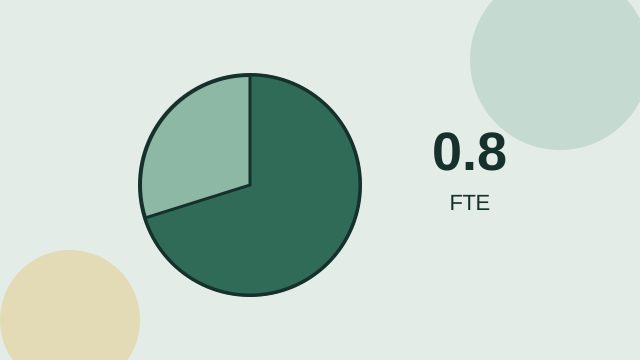
You work 80% of full-time hours — usually four days of a five-day week.
Do part-time workers get annual leave?
Yes. Part-time employees accrue annual leave in proportion to their ordinary hours.
Is full-time 38 hours in Australia?
The National Employment Standards set a maximum of 38 ordinary hours a week for full-time employees.
Will my tax drop in proportion?
No. Progressive tax rates mean take-home falls by less than your salary does.