What changed on 1 July 2026
Payday Super is the biggest change to how employers pay superannuation since the super guarantee began. Before 1 July 2026 employers could pay super quarterly, up to 28 days after the end of each quarter. From 1 July 2026 they must pay the super guarantee for each payday, and the contribution must reach the employee's fund within seven business days of that payday. The ATO's Small Business Superannuation Clearing House closed on the same date, so small employers now pay through their payroll software or another clearing service.
How to use the calculator
- Enter the qualifying earnings for one pay.
- Choose how often you pay — weekly, fortnightly or monthly.
- Pick the payday. The calculator counts seven business days forward, skipping weekends.
- Read the super owed for that pay, the deadline and the annual total if every pay is the same.
Worked example
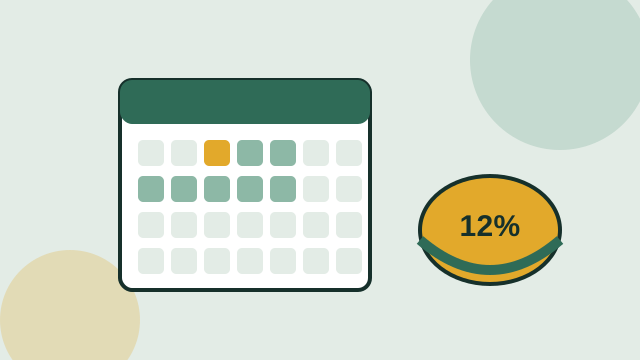
An employee earns $3,000 a fortnight. Super at 12% is $360.00 for each fortnightly pay, or $9,360 a year over 26 pays. If payday is Friday 13 November 2026, the contribution must reach the fund by Tuesday 24 November 2026, counting Monday to Friday only.
Qualifying earnings
Payday Super introduced "qualifying earnings" as the base for calculating the super guarantee. In most cases it starts with ordinary time earnings — what an employee earns for ordinary hours, including over-award payments, shift loadings, commissions and most allowances, but generally not overtime. It also counts amounts the employee has salary-sacrificed into super, so salary sacrifice cannot reduce the employer's compulsory contribution. Check the ATO's guidance for borderline payments such as bonuses and allowances.
Seven business days and public holidays
Business days exclude weekends and public holidays. This calculator skips weekends but cannot know every state and local public holiday, so in a week with a holiday the true deadline may be a day later. The safest approach is to send contributions on payday, which also leaves time for funds to process errors.
What happens if super is late
When a contribution doesn't reach the fund on time, the employer becomes liable for the super guarantee charge, which is calculated on the shortfall plus additional amounts, and late payment offsets are no longer available. The ATO has said it will take an education-focused approach in the first year to employers making a genuine effort to comply, but the obligation itself applies from 1 July 2026.
Checking your own super as an employee
Your payslip should show the super your employer has calculated for each pay. Log in to your fund's app or website to confirm contributions arrive within about a week of each payday. If they don't, ask your employer first, then contact the ATO. You can also generate a compliant pay record with the payslip generator.
Planning cash flow for super
For a business with ten employees each earning $3,000 a fortnight, super is $3,600 every pay run instead of about $23,400 a quarter. The total over a year is unchanged, but the money leaves the account in smaller, more frequent amounts and you lose the benefit of holding it for up to four months. Many employers set up a separate account for super and transfer the amount on payday so the funds are never at risk of being spent.
Common mistakes to avoid
Counting seven calendar days instead of business days, waiting for the fund to confirm before starting the clock, and calculating super on gross pay that includes overtime are the errors we see most. Another is forgetting that the deadline is when the fund receives the money, not when the payment leaves your bank. Allow time for clearing services and fund processing.
Frequently asked questions
When did Payday Super start?
1 July 2026. Wages paid on or after that date fall under Payday Super; super for the April–June 2026 quarter was still due by 28 July 2026.
How long do employers have to pay super?
The contribution must reach the employee's super fund within seven business days of payday.
What is the super guarantee rate?
12% of qualifying earnings, the rate that has applied since 1 July 2025.
Is the Small Business Superannuation Clearing House still available?
No. It closed from 1 July 2026, so employers need another way to pay, usually through payroll software.
Does salary sacrifice reduce the employer's super?
No. Salary-sacrificed amounts are included in qualifying earnings, so the employer's 12% is calculated as if the sacrifice hadn't happened.